In the evolving world of audio technology, POE amplifiers (Power over Ethernet amplifiers) are revolutionizing how we design and install audio systems. As both a POE amp and network device, these innovative solutions combine high-quality audio amplification with simplified installation through standard Ethernet cables, making the POE audio amplifier an increasingly popular choice in modern audio deployments.
This comprehensive guide will explore everything you need to know about POE amplifiers, including their working principles, key benefits, installation considerations, and practical applications in commercial, residential, and professional audio environments.
As the name suggests, a POE amplifier is an audio amplifier that can be powered through an Ethernet cable. It receives power signals through a standard Ethernet cable (such as Cat 5e or Cat 6), eliminating the need for traditional power outlets or additional power lines. The POE amplifier can connect to other devices (such as audio sources, audio processors, or controllers) via the network and provide high-quality audio amplification.
The working principle of POE amplifiers is based on the Ethernet protocol, achieving dual transmission of audio signals and power through the same Ethernet cable. Specifically, the audio source transmits audio signals through the network, while power is supplied through the power transmission part of the Ethernet cable. In this process, a POE switch or POE injector is responsible for inputting power into the cable, while the POE amplifier receives power from the network and drives audio amplification.
The core advantage of this technology is that it eliminates the dependence on power outlets and power lines in traditional audio systems. Especially in applications requiring long-distance audio transmission, POE amplifiers can transmit audio signals and power simultaneously through a single Ethernet cable, simplifying device connections and wiring work.
The Synergy of Dante and PoE
When combined with Dante technology, a POE amplifier becomes a powerful network node. It can receive high-resolution digital audio via the Dante protocol and draw power from the same network switch, making it a truly 'one-cable' solution for complex multi-room audio deployments.
When designing a networked audio system, understanding the relationship between the PoE standard and the actual audio wattage is crucial. The power delivered to your speakers depends entirely on the PoE handshake between your network switch and the amplifier.
PoE Power vs. Audio Performance Matrix
| Feature | Standard PoE (802.3af) | PoE+ (802.3at) | PoE++ (802.3bt) |
| IEEE Standard | IEEE 802.3af | IEEE 802.3at | IEEE 802.3bt |
| Max Power at Source | 15.4W | 30W | 60W - 90W |
| Max Power to Device | 12.95W | 25.5W | 51W - 71W |
| Typical Audio Output | 10W - 15W | 20W - 25W | Up to 60W |
| Best Application | Small hallways, VoIP paging | Conference rooms, Professional wall speakers | High-power subwoofers, Outdoor horn speakers |
Key Considerations for Power Planning
Power Loss over Distance: Using high-quality Cat6 oxygen-free copper cables ensures minimal voltage drop over long cable runs (up to 100 meters), allowing the POE amplifier to maintain peak output.
Dynamic Headroom: Our POE Amplifiers are optimized for high-efficiency Class D amplification, converting over 90% of the PoE power into acoustic energy for your passive speakers.
Switch Selection: Ensure your PoE Switch has a sufficient total power budget to support multiple high-power PoE++ channels simultaneously.
One of the biggest advantages of POE amplifiers is the simplification of audio system wiring. Traditional audio systems often require additional power lines, whereas POE amplifiers provide power and audio signals through standard Ethernet cables. This significantly reduces the number of cables during the installation process, lowering the complexity of installation and maintenance. Additionally, POE technology can reduce the need for traditional power outlets, which is especially important for many commercial and public places.
Since POE amplifiers are powered through Ethernet cables, they usually do not require additional power adapters or batteries. This compact design allows POE amplifiers to integrate better into various environments, making them especially suitable for space-limited occasions such as malls, restaurants, and conference rooms.
Modern POE amplifiers are usually equipped with network management functions, allowing users to remotely monitor and adjust devices via a network interface or control software. This feature is particularly useful for distributed audio systems, enabling system administrators to easily adjust the volume of each amplifier, input source settings, and even troubleshoot problems without needing to be on-site.
POE amplifiers utilize network cables for power supply, not only reducing redundant cables but also effectively minimizing energy loss. Compared to traditional power adapters, POE technology can provide more efficient power transmission, ensuring stable operation of the equipment.
POE amplifiers are typically designed with overload protection and current protection mechanisms to ensure that the equipment is not damaged due to unstable power or overload. Additionally, POE technology ensures standardized safety in power supply, making the equipment safer and more reliable during use.
As a modern audio solution, POE amplifiers, with their advantages in simplified wiring, space-saving, and increased system reliability, are gradually becoming the preferred choice in various audio application scenarios. Whether in commercial sound systems, public address systems, home theaters, or conference room audio systems, POE amplifiers can provide efficient and flexible audio transmission solutions. With the continuous development of technology and the popularity of smart devices, the application prospects of POE amplifiers in audio systems will become broader, becoming a key component in future audio systems.
The total wattage of a POE amplifier depends on the specific PoE standard it supports. Using the IEEE 802.3at (PoE+) standard, an amplifier can typically deliver 20W to 25W of high-efficiency Class D power. For more demanding applications, our latest IEEE 802.3bt (PoE++) models can drive up to 60W, which provides more than enough headroom for high-quality background music, professional paging, and even small-scale sound reinforcement in conference rooms.
Yes. One of the core benefits of a POE audio amplifier is its versatility. It acts as a digital-to-analog bridge, allowing you to connect standard 4Ω or 8Ω passive speakers via traditional speaker wire. This allows system integrators to upgrade existing analog ceiling or wall-mount speakers to a modern, network-controlled audio system without replacing the speakers themselves.
You will need either a PoE Switch or a PoE Injector that matches the power requirements of your amplifier (PoE+ or PoE++). For professional installations, especially those involving Dante audio, we strongly recommend using a Managed PoE Switch. This allows for better management of Multicast traffic and ensures that the audio clock synchronization remains stable across the network.
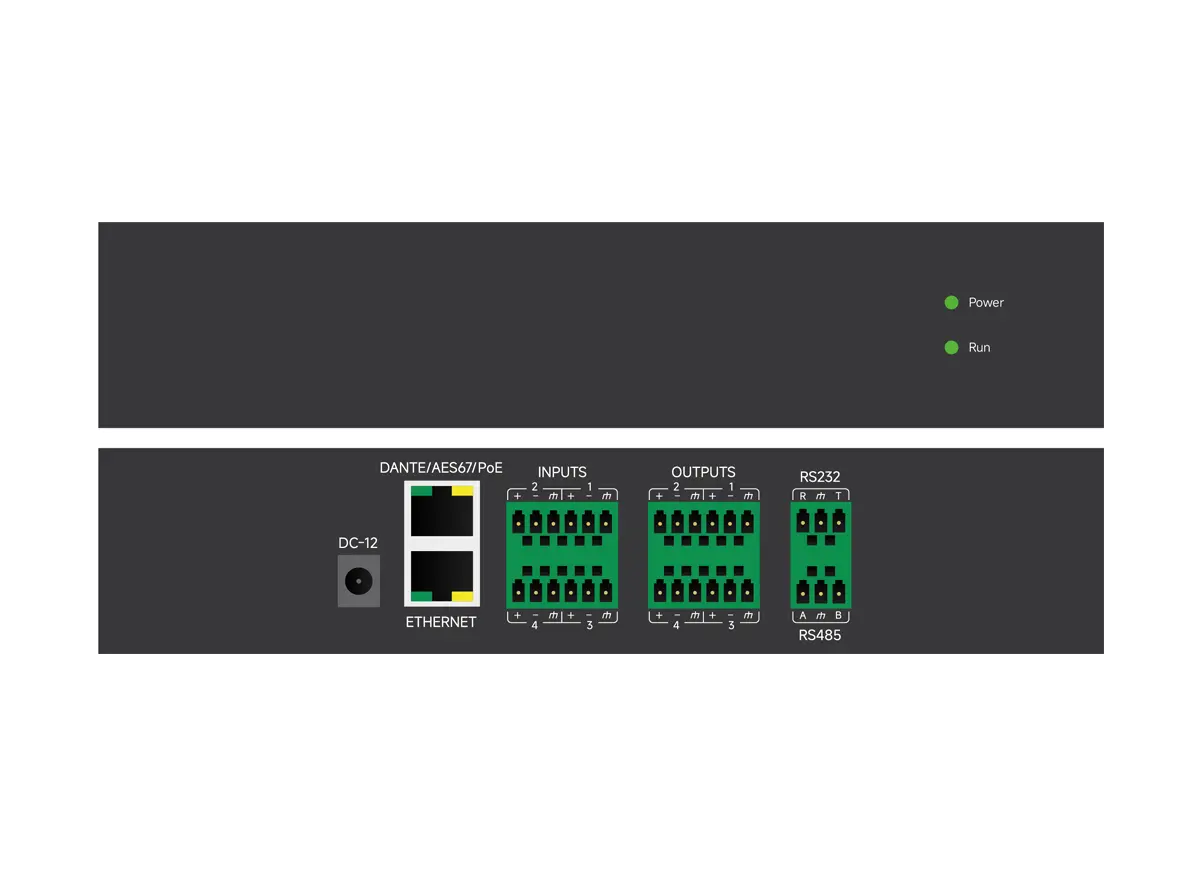
Absolutely. Our POE amplifiers are designed for seamless integration with Dante and AES67 protocols. When used alongside a Dante Audio Processor, the Dante POE amplifier can be discovered and routed instantly via software, providing a completely digital signal path from source to speaker.

 English